
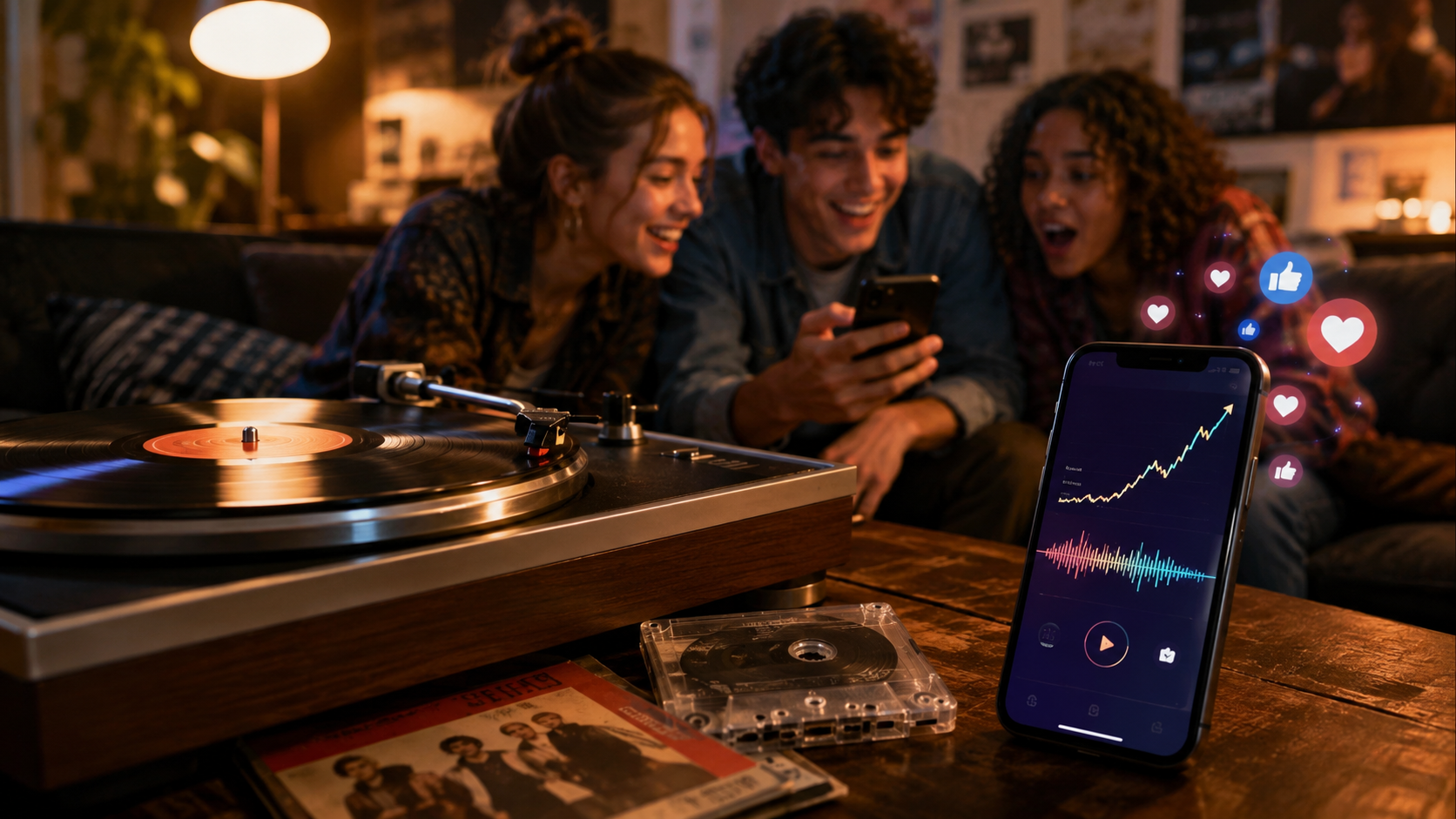
Something strange has been happening to the music charts. Alongside the freshly released singles you would expect to find there, songs from thirty, forty, even fifty years ago keep reappearing, sometimes climbing higher than they ever did on release. A track your parents danced to can suddenly become the most-streamed song on the planet, beloved by teenagers who were not born when it came out. This is not a fluke or a one-off act of nostalgia. It has become a recurring feature of how music works now, and understanding why reveals just how completely the rules of popularity have been rewritten.
The single biggest engine behind this phenomenon is TikTok. The platform runs on short clips, and a well-chosen snippet of a song can become the soundtrack to a viral trend, a dance challenge, or a particular aesthetic mood, spreading across millions of videos in days. Crucially, TikTok does not care how old a song is. A fifteen-second hook is a fifteen-second hook whether it was recorded last week or half a century ago, and the app’s algorithm pushes whatever resonates, regardless of release date. The most famous example remains the man who filmed himself skateboarding and sipping cranberry juice while lip-syncing to Fleetwood Mac’s “Dreams.” That single, mellow clip sent a decades-old song rocketing back up the charts, boosting its streams by hundreds of percent and pulling a track from the seventies back into the contemporary top ten. The band embraced it, the internet ran with it, and a new generation discovered the song as if it were brand new.
Television and film provide the other great launchpad, and here the effect can be even more dramatic. When a series or movie places an old song at an emotional peak of its story, it introduces that track to an enormous audience in a charged, memorable context. The clearest case in recent memory is Kate Bush’s “Running Up That Hill,” a song from the mid-eighties that featured prominently in a climactic scene of a hugely popular Netflix series. The placement sent the track to the top of charts around the world, decades after its original, more modest success, and made it a streaming sensation among listeners who had never heard of the artist. Music supervisors say the trick is not simple nostalgia but narrative context: when a song mirrors a character’s emotional turning point, viewers feel compelled to seek out the full track the moment the episode ends. The same pattern has revived everything from soft rock to heavy metal, and a single well-placed scene in a film has repeatedly pushed forgotten songs onto the charts for the first time.
Underpinning both of these is a structural change in how we listen, one that quietly tilts the entire playing field toward older music. In the streaming era, a listener’s entire history of recorded music sits one tap away, equally accessible. The catalog, meaning anything older than around a year and a half, is no longer locked in dusty record shops or dependent on radio programmers choosing to play it. It lives right alongside the newest releases on the same apps, in the same search bars, woven into the same algorithmic playlists. When a streaming service’s recommendation system or a curated playlist surfaces an old track, it can find an audience instantly, and that audience’s listening feeds back into the system, amplifying the song further. Old music is increasingly treated by young listeners not as old at all, but simply as music they have just discovered.
The chart rules themselves have adapted to this reality, which is why these revivals show up as official hits rather than mere curiosities. Modern charts count streams and digital engagement for catalog recordings on equal footing with brand-new releases. A song from decades ago that suddenly racks up millions of streams in a single week competes directly with the latest pop single, and can outrank it. This is a profound shift. In the past, getting a song onto the radio and into the charts required money, promotion, and industry muscle. Now a spontaneous wave of public enthusiasm, sparked by a video or a scene, can accomplish the same thing on its own, and one label executive described a decades-dormant song spontaneously reappearing on radio as a genuine watershed moment.
There is also a deeper, more human current running beneath the technology: the steady pull of nostalgia, and the way it moves in cycles. Each generation tends to romanticize the era just before its own, and culture has a habit of circling back to revisit sounds every couple of decades. The aesthetics of the past become fashionable again, and with them the music. What is new is that the tools to act on that nostalgia are now instant and universal. In earlier times, a nostalgic revival might play out slowly over years through reissues and oldies radio. Today it can happen overnight, when a single creator’s clip taps into a shared feeling and millions of others pile on.
The industry has noticed, of course, and has begun to respond in kind. Labels now actively prepare their back catalogs for potential revivals, knowing that any song in their vaults could be one viral moment away from a second life. The rights to old hits have become more valuable precisely because their earning potential no longer ends when they fade from the charts the first time. A great song is now a renewable asset, capable of returning again and again.
What all of this adds up to is a music landscape that is no longer linear. The old assumption that a song has one moment, charts, peaks, and then recedes into the archive, has dissolved. A track can now have two, three, or more distinct lives, separated by decades, each sparked by a different cultural trigger. For the artists behind these songs, many of whom had long since stopped expecting anything from them, it can mean a sudden, surreal return to relevance and a windfall of new fans. For listeners, it means the charts have become a place where past and present mingle freely. The scenic route to success, as one observer put it, sometimes just takes a little more time and a Wi-Fi connection. In an age when the internet never forgets a good groove, no song is ever truly finished.